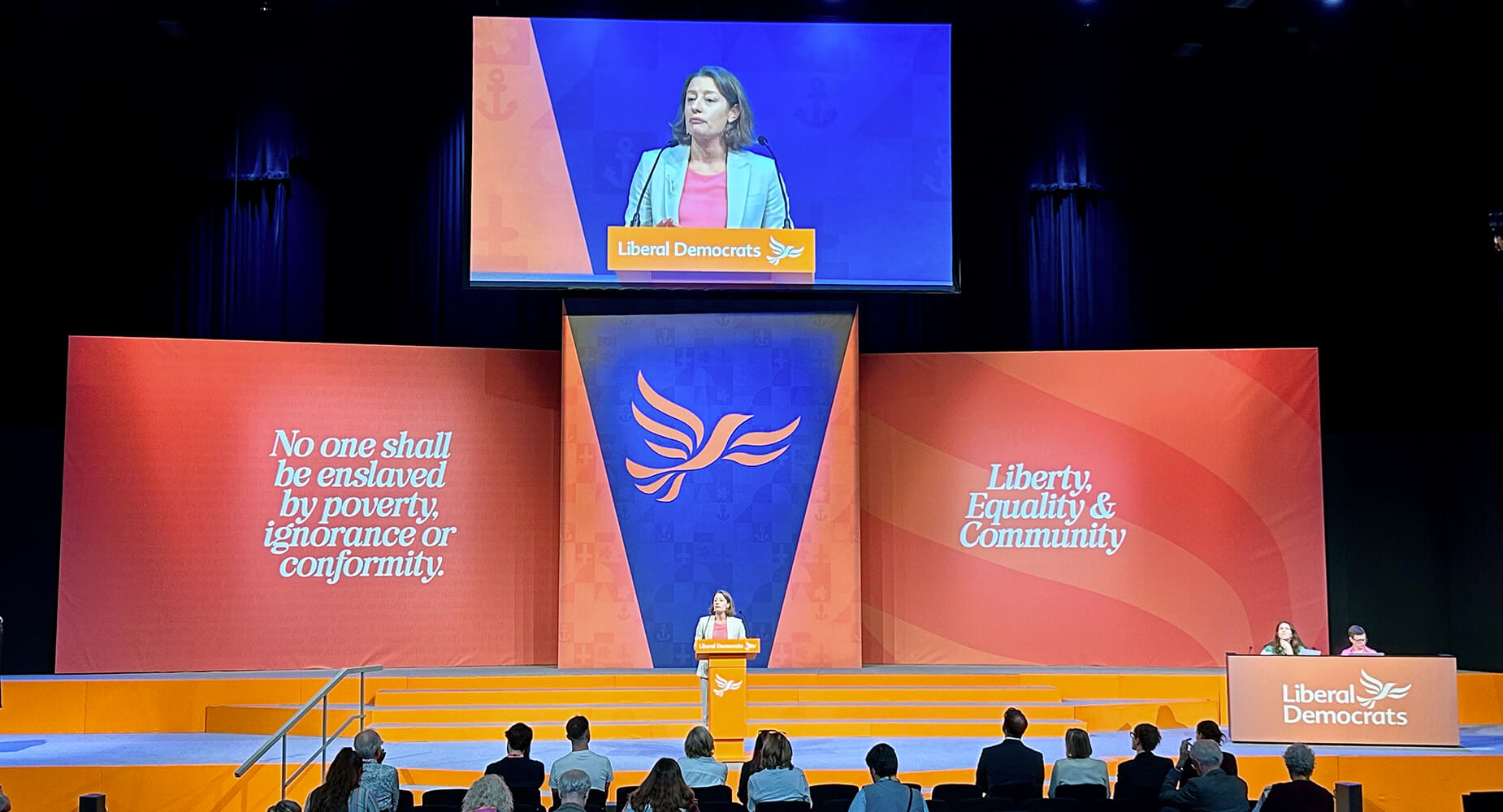
The Liberal Democrats should be in one of the strongest positions in their recent history. With 72 MPs and a formidable local campaigning machine, the party has more parliamentary clout than it has had for decades. That parliamentary strength, however, has not translated into the same level of national political cut-through. That contradiction hung over the party’s conference in Brighton. The Lib Dems remain at around 10-12% in national polling, while Reform and the Greens – despite having a fraction of their representation in Parliament – have often been far more successful at commanding attention, even with Ed Davey’s enthusiasm for a headline-grabbing stunt.
The numbers underline the challenge. Research presented by More in Common found that Britons were four times more likely to have heard from Reform than the Liberal Democrats in recent months, and seven times more likely to have seen Nigel Farage on social media than Ed Davey. Unsurprisingly, frustration is beginning to show. Devon County Council leader Julian Brazil used conference to warn that the party risked becoming irrelevant and questioned whether Davey was the right person to lead it.
But there is a slightly unusual dynamic to the pressure on Davey. He can reasonably point to the party’s best General Election result in a century and continued success in local government. There is also no obvious successor and little sign of an appetite among Lib Dem MPs for a leadership contest. The bigger question coming out of conference, therefore, is less about who leads the Liberal Democrats and more about where the party goes next.
There was certainly no shortage of policy in Brighton. Davey promised to raise the personal allowance to £15,000, while the Lib Dems went further on Europe by calling for full single market membership and arguing that closer economic ties would generate the growth needed to fund its tax plans. There were also announcements on fuel duty, health and political finance, while Davey made AI a major feature of his closing speech, calling for a global treaty and international AI safety agency.
Business was another area where the Lib Dems sought to sharpen their offer, including proposals to reduce the regulatory burden on companies and improve access to finance. Combined with the tax and Europe announcements, there are the beginnings of a more distinct economic pitch – closer ties with Europe to drive growth, alongside lower taxes and a more business-friendly domestic environment.
The challenge, then, was not a lack of policy, but the absence of an obvious political story tying it all together. As the party’s new president Josh Babarinde put it during conference, the Lib Dems have plenty of policies but need to get much better at telling that story.
That feeds into a wider question about the Lib Dems’ electoral strategy. The party has become extremely good at identifying the constituencies where it can win and relentlessly targeting them. Much of that strategy remains focused on consolidating support among moderate and former Conservative voters, particularly in the southern seats where it made significant gains in 2024. The tax-cutting message and pro-European positioning are designed with those voters in mind. It delivered spectacularly in 2024, but there is a question over how much further the same approach can take them, with pollster Sir John Curtice arguing that the party may have reached the limits of that model.
And then there is the question that inevitably follows the Lib Dems around: coalition. Davey spent much of conference being asked what he would do in a hung Parliament, while trying to keep the focus on what the party would do in its own right.
For businesses, that uncertainty is not a reason to ignore the party. The Lib Dems do not need to be challenging to form a government outright to influence policy. More than 70 MPs gives them significant parliamentary weight, particularly as British politics becomes increasingly fragmented. And as the Lib Dems develop their policy platform ahead of the next election, businesses have an opportunity to engage early on the issues that matter to them.
Brighton ultimately left the Lib Dems facing a different challenge from the one they faced before the last election. They have proved they can win seats. The task now is turning that electoral success into a clearer national role and greater political influence.